Winter in Nice in figures: a one-to-three swing
Let's start with the data, because it sets expectations. According to AirROI, the median monthly revenue of a listing in Nice reaches $4,028 in August, against $1,388 in January, with occupancy of 61% at the peak versus 31% in the trough (August 2025 to July 2026). In other words, January earns roughly a third of what August does for a median listing.
The monthly barometers published by the metropolitan Tourist Office confirm the trend. Occupancy of holiday lets fell to 24% in November 2025 and 28% in December 2025, against 66% in August 2025. For hotels, revenue per available room hits its low point in January, described by the Tourist Office as the "annual trough", before recovering in February with Carnival.
A summer strategy applied to winter does not work: same prices, same minimum stays, same listing, and the calendar stays empty.
The goal in winter is not to match summer. It is to cover your fixed costs (service charges, energy, insurance, mortgage) and make a margin, rather than leave the property empty for five months.
Winter highlights in Nice you shouldn't miss
Winter in Nice is punctuated by short but profitable spikes in demand. Spotting them early lets you open your calendar at the right price, rather than discovering the event once everything is booked.
- November: the Nice-Cannes marathon. The Tourist Office recorded a peak of 40% occupancy in holiday lets that weekend in November 2025, in an otherwise very quiet month.
- Late December: the festive season and New Year. In 2025, holiday-let occupancy approached 60% around New Year's Eve according to the Tourist Office, against 28% over the month as a whole.
- February: the Nice Carnival, from 9 to 28 February 2027 according to the Tourist Office. In February 2026, hotel occupancy reached 73% and revenue per room rose 14% year on year.
- March: MIPIM, the international property fair, from 16 to 19 March 2027 in Cannes according to mipim.com. Some attendees stay in Nice, often booking late.
For Carnival, we have written a full guide to pricing and minimum stays: Airbnb during the Nice Carnival. To miss no dates, sign up to our event price alerts for the Riviera, which tell you when to open your calendar and when to adjust prices.
Open your Carnival and MIPIM dates at least four months ahead, with a two-night minimum on parade weekends. Then adjust the price according to how quickly bookings come in.
Month-long stays: the guests who rescue winter
Between events, the real resource of a Nice winter is long stays. European retirees escaping the northern cold, families in transition, employees on assignment, remote workers who want a month in the sun: these guests book several weeks at once and cut the number of turnovers accordingly.
Airbnb has dedicated tools. In your listing's price settings you can set a weekly discount (7 nights or more) and a monthly discount (28 nights or more). According to the Airbnb Help Centre, discounts of 10% or more are highlighted in search results, and payments for monthly stays are collected and released in monthly instalments.
A monthly discount is not a gift: it reflects real savings. In winter, a 28-night stay replaces several short bookings, each with its own cleaning, laundry, check-in and risk of an empty night in between. The right discount is therefore calculated from your turnover costs and your actual winter occupancy, not plucked from the air.
Airbnb itself points out that in some jurisdictions a guest may acquire tenant rights after a month. For a long stay, check the applicable legal framework and, if in doubt, seek advice from a property law professional.
Remote workers: guests who are demanding about Wi-Fi
An international airport, neighbourhood life all year round, and a mild winter compared with northern Europe: Nice attracts people who can work remotely. They book several weeks, read the reviews and expect a home designed as a workplace as much as a holiday base.
- A stable fibre connection, with the speed stated in the listing (a screenshot of a speed test reassures more than a promise).
- A proper workstation: a table at the right height, a comfortable chair, a socket within reach, good lighting.
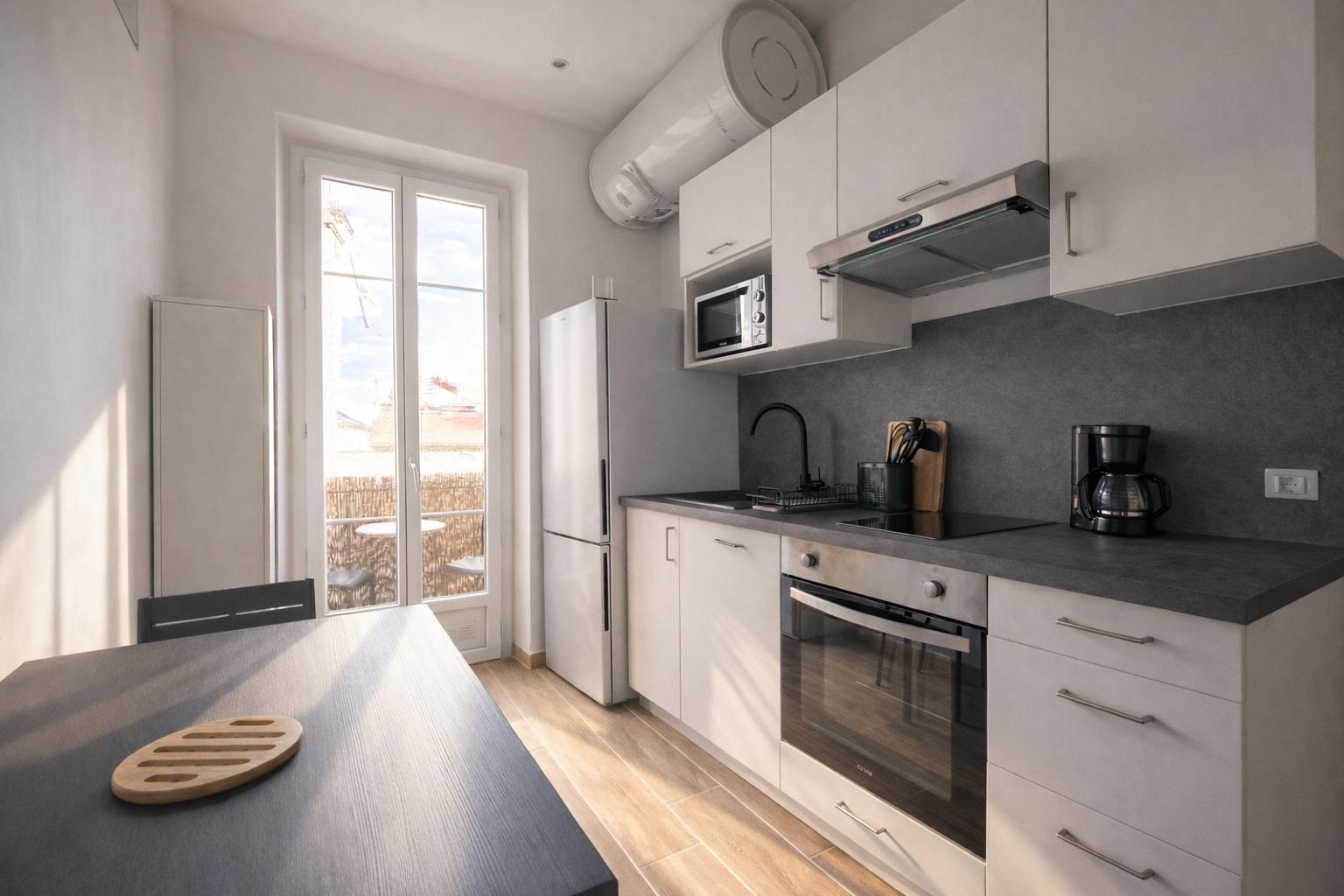
- A genuinely equipped kitchen, since guests will cook most of their meals.
- A washing machine, essential once a stay goes beyond a week.
- Quiet: state the floor, the aspect and the street noise level. In Old Nice or around Place Masséna, be honest about noise.
A regulatory point: a remote worker who stays a month simply to enjoy living in Nice is generally a passing guest, not a mobility-lease tenant. Their stay therefore falls under holiday-let rules, with whatever restrictions apply to your property (see below). The mobility lease is reserved for specific reasons, set out in the next section.
The mobility lease: letting for 1 to 10 months without change of use
The mobility lease (bail mobilité) is the most powerful tool for a Nice winter, provided you understand it properly. According to service-public.fr, it is a furnished lease lasting 1 to 10 months, which cannot be renewed or rolled over. Its length may be changed once by amendment, provided the total does not exceed 10 months. The landlord may not ask for a security deposit but may require a guarantor, and the tenant can use the Visale guarantee scheme.
It is reserved for people who, when the lease starts, are in vocational training, higher education, an apprenticeship, an internship, voluntary civic service, a professional transfer or a temporary assignment. In Nice, that covers, for example, hospital junior doctors and healthcare staff, engineers on assignment at Sophia Antipolis, students on placement or employees being relocated.
Its big advantage: the mobility lease is a residential use, not a holiday let. It therefore does not require change-of-use authorisation. For an owner whose second home did not obtain authorisation in a quota zone, it is a lawful way to let for short periods. For an owner who does hold authorisation, it is a way to fill the quiet months before returning to nightly lets in spring.
The contract must state explicitly that it is a mobility lease, otherwise it loses that status. The property must also meet the rules for furnished residential lets, including the minimum furniture list and the decent-housing criteria. We explain how it works and our terms on our mobility lease in Nice page, and the tenant profiles in our article who rents on a mobility lease in Nice.
La Joyeuse manages mobility leases with Cabinet Immobilier Nice, at 15% excl. VAT (18% incl. VAT) of rent collected: listing, eligibility checks, lease, check-in and check-out inventories, and cleaning between tenants.
Mixed letting: nightly in summer, mobility lease in winter
Many Nice owners combine the two models. From April to October, the property is let by the night, when tourist demand is strong and prices high. From November to March, it switches to a mobility lease or long stays, with a more modest monthly rent but steady occupancy.
This approach means respecting the framework of each use. If the property is your main residence, the tourist side remains capped at 120 days a year without authorisation (see our page on the 120-day main-residence rule). If it is a second home, short-term letting to tourists requires change-of-use authorisation. Since 1 September 2026, this is temporary (5 years, non-renewable) and capped in four zones of the city. The mobility lease does not require this authorisation.
Your calendar must be built accordingly. A four-month mobility lease signed in November frees the property in March, just before tourist demand picks up in spring. A ten-month lease, on the other hand, would cost you the entire high season. To compare scenarios for your property, use our rental strategy comparison for Nice.
Do not mix up the two regimes. Letting a second home by the night without change of use exposes you to a fine of up to €100,000 per property. If you are unsure of your situation, check it before reopening your calendar.
Pricing and minimum stays: setting up your listing for winter
In winter, pricing mistakes are expensive. Too high, and your listing disappears behind the competition. Too low, and you fill nights that do not cover the cleaning. The right approach is to think in periods rather than one price for the whole winter.
Outside events: lower the minimum stay, not just the price
In the quiet weeks of November and January, a 3- or 4-night minimum blocks weekend bookings that could have filled a gap. Relaxing this rule, particularly for orphan nights between two bookings, often earns more than an across-the-board price cut.
During events: hold the minimum stay and the price
During Carnival or MIPIM, the opposite applies. The demand is there: set a two-night minimum on key dates and do not drop prices too early. Business guests book late; holding your price until a week before arrival often pays off.
To estimate what your property can realistically earn month by month, winter included, get a free estimate of your Airbnb income in Nice.
Heating and winter kit: the comfort that drives reviews
It is easy to forget: many flats in Nice are designed for summer. Cold tiled floors, single glazing, a reversible air conditioner never tested in heating mode. A guest who is cold leaves a review, and that review stays visible all the following summer.
If you let on a mobility lease, heating is not optional: decree no. 2002-120 on decent housing requires an installation allowing normal heating, suited to the characteristics of the dwelling. For holiday lets, it is mainly a matter of ratings and bookings.
- Have the reversible air conditioning or radiators checked before November, and clean the filters.
- Provide a warm duvet as well as summer sheets, and a throw per guest.
- Add rugs on tiled floors in living areas and bedrooms.
- Check window seals and bedroom blackout: winter nights are long.
- State the heating system clearly in the listing to avoid unpleasant surprises.
- Leave simple instructions for using the air-conditioning remote in heating mode.
For the full list of what to provide in a rental in Nice, summer and winter, see our guide to Airbnb equipment in Nice.
Making the most of the low season: works, photos and listing
Winter has one advantage summer lacks: time. Weeks without bookings are ideal for everything that is impossible in peak season.
- Small works: painting, bathroom seals, replacing tired bedding, repairing blinds.
- Refreshing the decor, so your listing stands out in spring (see our article on Airbnb decoration in Nice).
- A new photo shoot, to be done before demand picks up. Nice's winter light, often clear and low, suits interior photography well.
- Updating the listing: description, amenities, house rules, practical information.
- Paperwork: checking your registration number, your energy performance certificate (DPE), and possibly getting your holiday let classified.
If you would like an outside view of your listing before spring, request a free Airbnb listing audit: we identify what is holding back your bookings.
And if managing two seasons feels like a lot, that is exactly what we do. Our Airbnb concierge service in Nice adapts prices, minimum stays and distribution channels to each period, for a commission of 20% excl. VAT (24% incl. VAT) of revenue, with no lock-in and a detailed report every Friday.